Advantages and Disadvantages of Butterfly Valves
Add time:2017/3/23 9:04:40 Page views:2511
A butterfly valve is a valve whose closing member is a disc‑shaped butterfly disc. The disc rotates around its own axis inside the valve body to realize opening, closing or flow regulation. The rotation angle from full‑open to full‑closed position of a butterfly valve is generally less than 90°. Neither the butterfly valve nor its stem has self‑locking capability. To position the butterfly disc, a worm‑gear reducer shall be fitted on the valve stem. The worm‑gear reducer not only provides self‑locking performance for the disc to hold at any arbitrary position, but also improves the operating performance of the valve.
Special‑purpose industrial butterfly valves feature high‑temperature resistance and a relatively wide applicable pressure range with large nominal diameters. Their valve bodies are made of carbon steel, and metal rings are adopted for the disc sealing rings instead of rubber rings. Large‑size high‑temperature butterfly valves are fabricated by steel plate welding, and are mainly used for flue gas ducts and gas pipelines carrying high‑temperature media.
Advantages of Butterfly Valves
Easy and fast opening‑closing operation with low labor consumption, low fluid resistance, and suitable for frequent operation.
Simple structure, compact size and light weight.
Applicable for slurry transportation with minimum liquid accumulation at pipeline ends.
Satisfactory sealing performance can be achieved under low‑pressure conditions.
Good regulating performance.
Disadvantages of Butterfly Valves
Narrow range of service pressure and working temperature.
Relatively poor sealing performance.
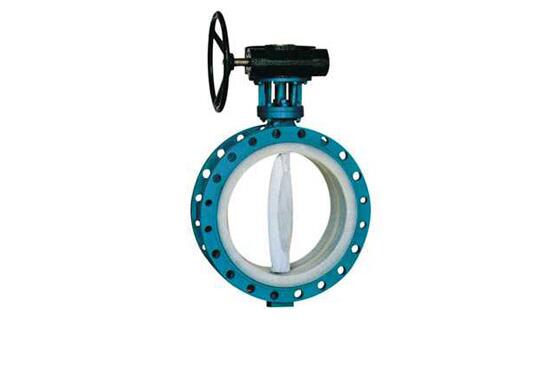
Butterfly valves can be classified by structural type into offset‑plate type, vertical‑plate type, inclined‑plate type and lever type. According to sealing form, they fall into soft‑seal type and hard‑seal type. The soft‑seal type generally adopts rubber‑ring sealing, while the hard‑seal type usually applies metal‑ring sealing.
In terms of connection type, they are divided into flange connection and wafer‑type connection. By actuation mode, they include manual, gear‑driven, pneumatic, hydraulic and electric types.
The following points shall be noted for the installation and maintenance of butterfly valves:
During installation, the disc shall remain in the closed position.
The opening position shall be determined according to the rotation angle of the butterfly disc.
For butterfly valves equipped with bypass valves, open the bypass valve prior to valve opening.
Installation shall be carried out in accordance with the manufacturer’s installation instructions. For heavy‑weight butterfly valves, firm foundations shall be provided.


 Company News



 Chinese
 English